AAKASH
AAKASH
Base design system
Base design system
Building a universal design system powering 6 products across Aakash
Building a universal design system powering 6 products across Aakash
Introduction
Introduction
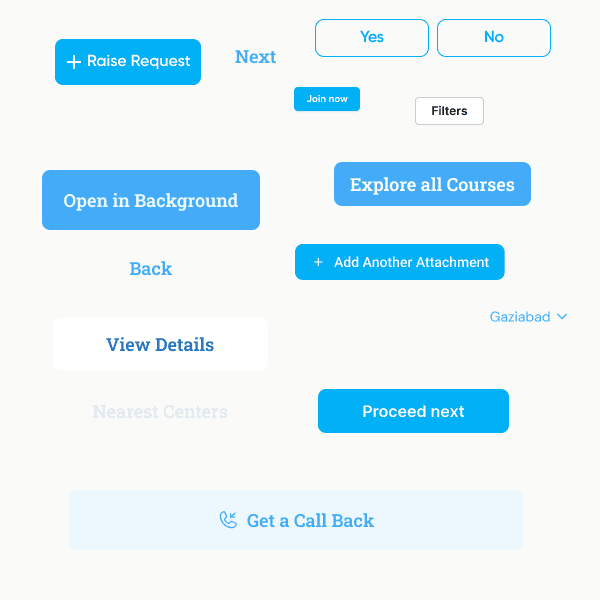
Seven product teams, seven ways to build a button!
Seven product teams, seven ways to build a button!
That sentence lived in our roadmap and in the daily friction between designers and devs. I proposed this design system in order to stop wasted design time, reduce bugs, and give product teams a shared toolkit that saved hours and cut rework
That sentence lived in our roadmap and in the daily friction between designers and devs. I proposed this design system in order to stop wasted design time, reduce bugs, and give product teams a shared toolkit that saved hours and cut rework
My Role as an independent designer
End-to-end, Lead designer
End-to-end, Lead designer
I led the initiative end-to-end: auditing existing interfaces, defining cross-platform tokens, building components, and partnering with engineers to ship a code-backed system and adoption playbook
I led the initiative end-to-end: auditing existing interfaces, defining cross-platform tokens, building components, and partnering with engineers to ship a code-backed system and adoption playbook
Design systems work is much more about people than pixels
Design systems work is much more about people than pixels
Problems we faced
Problems we faced
Issues holding our product teams back
Issues holding our product teams back
As our product ecosystem grew, so did the gaps between teams. What started as small inconsistencies turned into UI debt, slower execution, and rising frustration. Major problems we faced were,
As our product ecosystem grew, so did the gaps between teams. What started as small inconsistencies turned into UI debt, slower execution, and rising frustration. Major problems we faced were,

Execution speed
Most time went to fixing handoffs, delaying releases and pushing ideas to backlogs
Execution speed
Most time went to fixing handoffs, delaying releases and pushing ideas to backlogs
Design dev collaboration
UI debt caused misalignment, back-and-forth fixes, and slower delivery
Design dev collaboration
UI debt caused misalignment, back-and-forth fixes, and slower delivery

Scalability
7 products were using seven design languages, making it hard to ship features quickly
Scalability
7 products were using seven design languages, making it hard to ship features quickly
Inconsistency
Different styles and patterns led to a broken experience and constant rework
Inconsistency
Different styles and patterns led to a broken experience and constant rework
Why this mattered?
Why this mattered?
Inconsistent UI meant poor user experience, more bugs, and slower product velocity
Our goal was clear: one system that reduces friction, speeds implementation, and scales with the teams
Inconsistent UI meant poor user experience, more bugs, and slower product velocity
Our goal was clear: one system that reduces friction, speeds implementation, and scales with the teams
Solution was obvious
Solution was obvious
A single design system for all products
A single design system for all products
With this born the nomenclature "Base", serving as a foundation for all of our products
With this born the nomenclature "Base", serving as a foundation for all of our products
Base design system
Exam management (Enterprise)
Exam management (Enterprise)
Phoenix (Enterprise)
Phoenix (Enterprise)
Aakash Guru (Enterprise)
Aakash Guru (Enterprise)
Crystal (B2C)
Crystal (B2C)
Vyom (B2C)
Vyom (B2C)
MyAakash (B2C)
MyAakash (B2C)
Aakash DLP (B2C)
Aakash DLP (B2C)
The approach
The approach
Process we followed while implementing the DS
Process we followed while implementing the DS
Rather than jumping straight into building components, we followed a structured process. We audited existing patterns, defined a shared foundation, tested it with teams in real work, and only then moved to implementation.
Rather than jumping straight into building components, we followed a structured process. We audited existing patterns, defined a shared foundation, tested it with teams in real work, and only then moved to implementation.
Step 1
Component audit
We reviewed seven products and mapped 180+ component variations, uncovering duplication and inconsistencies slowing teams down.
Step 1
Component audit
We reviewed seven products and mapped 180+ component variations, uncovering duplication and inconsistencies slowing teams down.
Step 2
DS Creation
We built tokens, patterns, and core components, giving all teams a shared visual language for the first time.
Step 2
DS Creation
We built tokens, patterns, and core components, giving all teams a shared visual language for the first time.
Step 3
Team usage & feedbacks
Designers tested early components, helping us refine real-world gaps and shape a system teams actually wanted to use.
Step 3
Team usage & feedbacks
Designers tested early components, helping us refine real-world gaps and shape a system teams actually wanted to use.
Step 4
Code implementation
We translated designs into reusable coded components and synced them with Figma, reducing handoff friction dramatically.
Step 4
Code implementation
We translated designs into reusable coded components and synced them with Figma, reducing handoff friction dramatically.
Step 5
Component QA & Rollout
Each component passed visual and functional QA before we rolled it out to all teams for daily use.
Step 5
Component QA & Rollout
Each component passed visual and functional QA before we rolled it out to all teams for daily use.
Step 6
Feedback tracking and upgrade requests
Feedback sheets to track QAs bugs, new component requirements & deprecate nonusable components
Step 6
Feedback tracking and upgrade requests
Feedback sheets to track QAs bugs, new component requirements & deprecate nonusable components
Things we focused on while executing
Things we focused on while executing
Tokens first
Tokens first
A cross-platform token map to guarantee consistent color/spacing/typography across design and code
We also, overrid existing tailwind CSS tokens with our own naming convention which gave us advantage of easier design understanding and developer alignment
A cross-platform token map to guarantee consistent color/spacing/typography across design and code
We also, overrid existing tailwind CSS tokens with our own naming convention which gave us advantage of easier design understanding and developer alignment
module.exports = {
  theme: {
    borderRadius: {
      "border-radius-small": "4px",
      "border-radius-medium": "6px",
      "border-radius-large": "8px",
      full: "9999px",
    },
  },
};
Component audit → build → feedback loop
Component audit → build → feedback loop
Audit existing components, design system creation, team trial, then iterate
Audit existing components, design system creation, team trial, then iterate
Developer alignment
Developer alignment
Map Figma components to JSX and provide usage rules and code samples so engineers could consume components fast
Map Figma components to JSX and provide usage rules and code samples so engineers could consume components fast
Things we focused on while executing
Things we focused on while executing
Variables
Variables
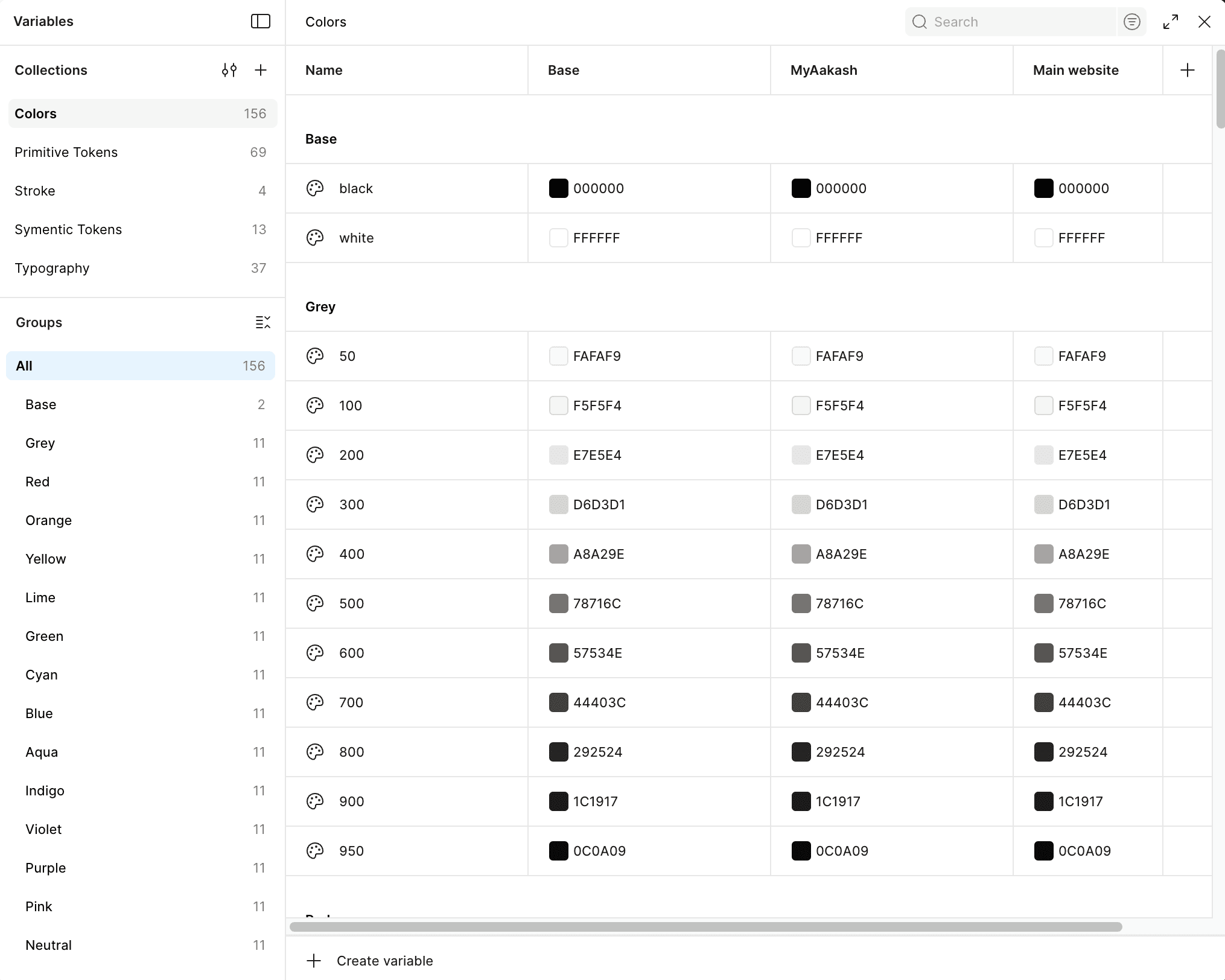
Symentic tokens
Symentic tokens
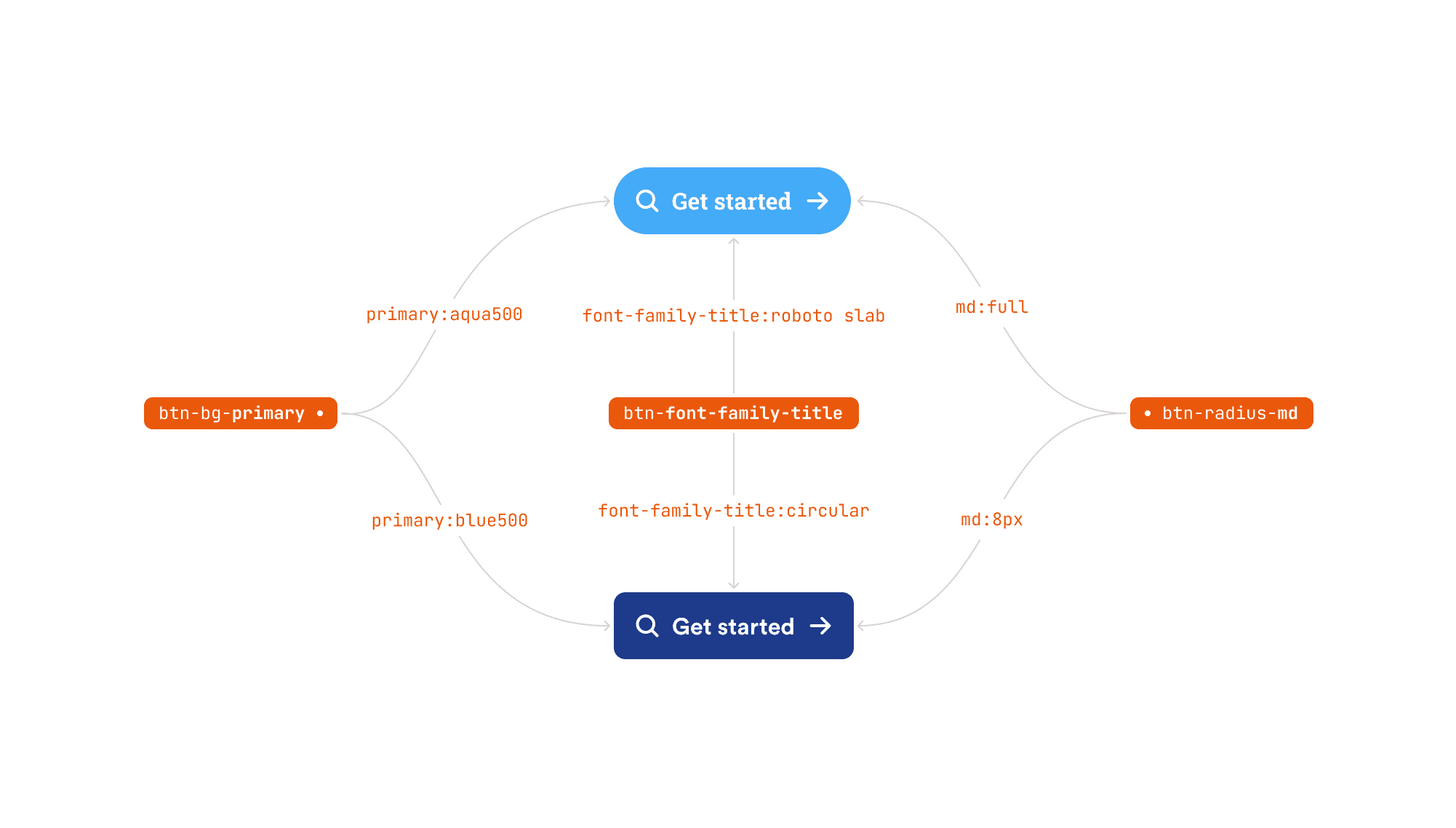
Semantic tokens remove hardcoded values from components and replace them with intent-based variables. This creates a clear contract between design and code, making theming, global updates, and long-term maintenance much easier and safer.
For eg, single button codebase themed differntly across different platforms
Semantic tokens remove hardcoded values from components and replace them with intent-based variables. This creates a clear contract between design and code, making theming, global updates, and long-term maintenance much easier and safer.
For eg, single button codebase themed differntly across different platforms
// Base design system

<div className="base-ds">
  <Button

  variant="primary"
  size="md"
  leftIcon={<MagnifyingGlass
  size={16}
  weight="bold"/>}
  rightIcon={<ArrowRight size={16}
  weight="bold" />}>

  Get started

</Button>
</div>
// My Aakash App

<div className="base-ds">
  <Button

  variant="primary"
  size="md"
  leftIcon={<MagnifyingGlass
  size={16}
  weight="bold"/>}
  rightIcon={<ArrowRight size={16}
  weight="bold" />}>

  Get started

</Button>
</div>
Typography
Font for Base Design System
Circular Std
The universe is a vast and intricate expanse, filled with countless galaxies.
Choose product to change typo
My Aakash
Phoenix
Vyom
Aakash DLP
Typography
Font for Base Design System
Circular Std
The universe is a vast and intricate expanse, filled with countless galaxies.
Choose product to change typo
My Aakash
Phoenix
Vyom
Aakash DLP
Color pallete
Color pallete
Color pallete
Color pallete
The color system was rebuilt from the ground up using a token-driven approach. Contrast-tested values to meet AA/AAA for future scope.
The color system was rebuilt from the ground up using a token-driven approach. Contrast-tested values to meet AA/AAA for future scope.
// Paste a code snippet

module.exports = {
  theme: {
    extend: {
      colors: {
        brand: {
          myaakash: {
            primary: "#1A73E8",
            secondary: "#185ABC",
            accent: "#E8F1FF",
          },
          phoenix: {
            primary: "#FF6B00",
            secondary: "#CC5600",
            accent: "#FFF1E6",
          },
Iconography
Iconography
Phosphorus icon library
Phosphorus icon library
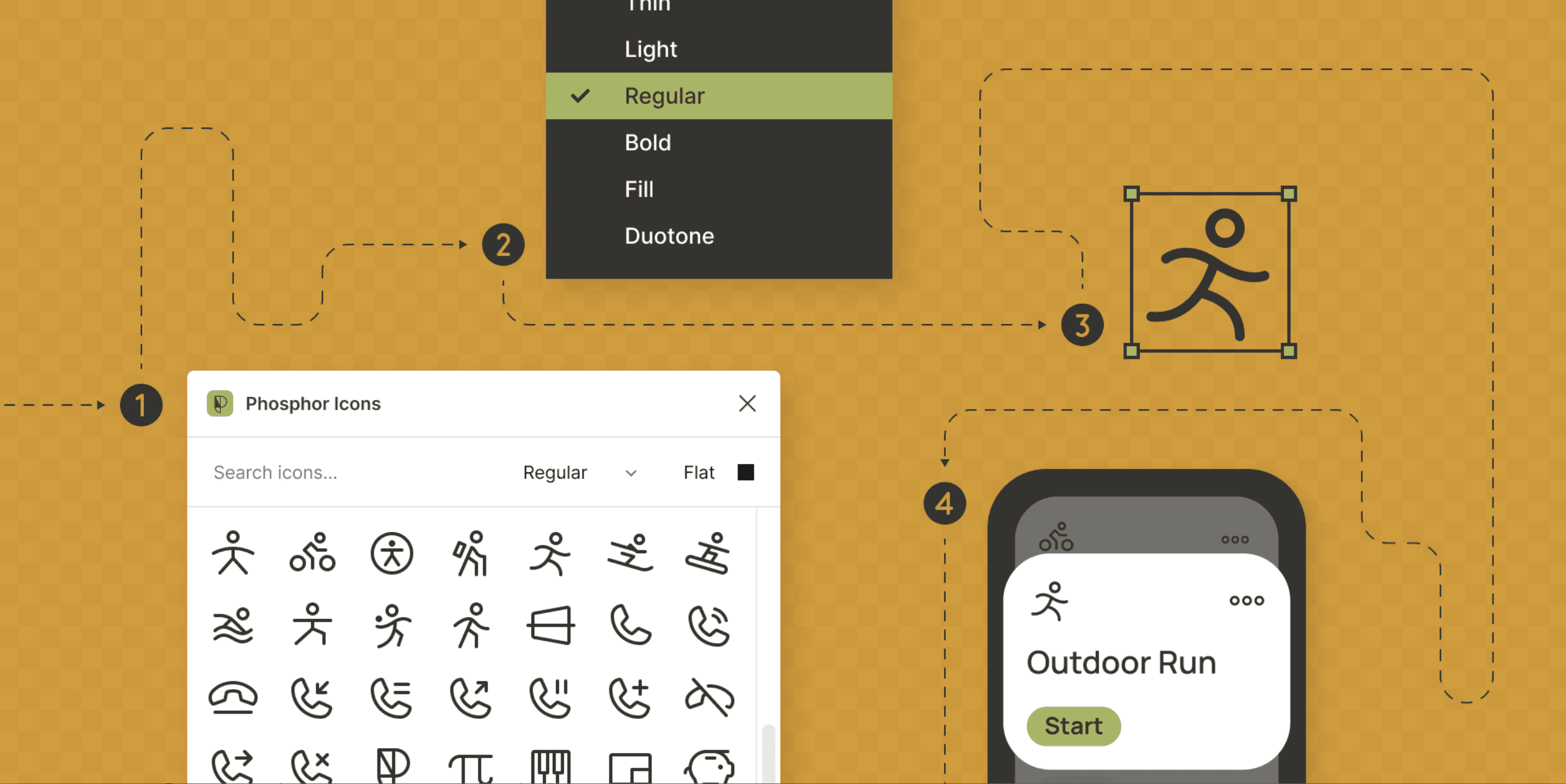
All the icons were inconsistent across 7 products. A simple back arrow had more variations which we can't count, and we spent time editing its margins.
Thus, we used a unified library, Phosphorus Icons. One major benefit was using icon weights seamlessly integrated with our different brand languages
All the icons were inconsistent across 7 products. A simple back arrow had more variations which we can't count, and we spent time editing its margins.
Thus, we used a unified library, Phosphorus Icons. One major benefit was using icon weights seamlessly integrated with our different brand languages
// Paste a code snippet

import phosphorus icon library
Grid & layouts
Grid & layouts
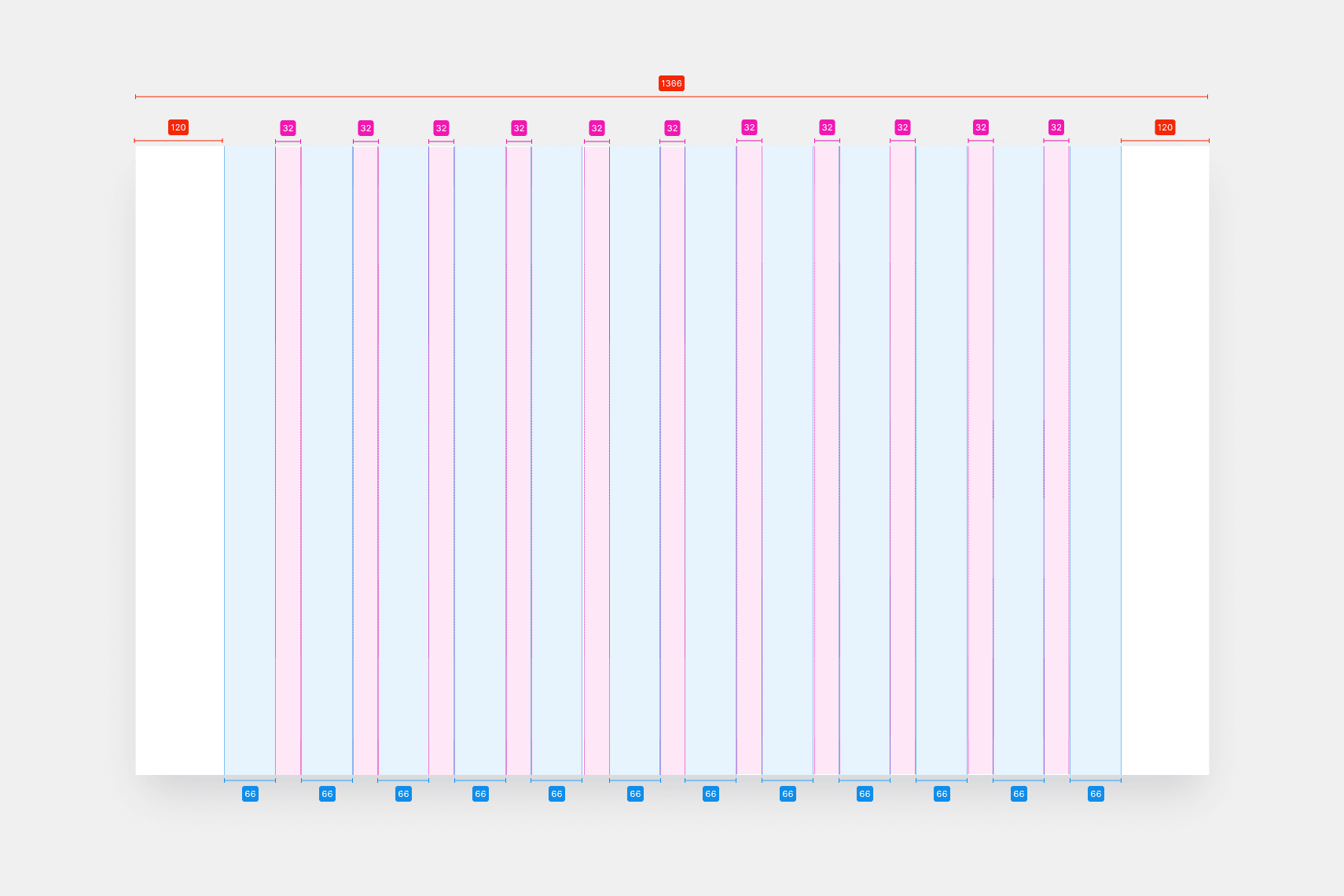
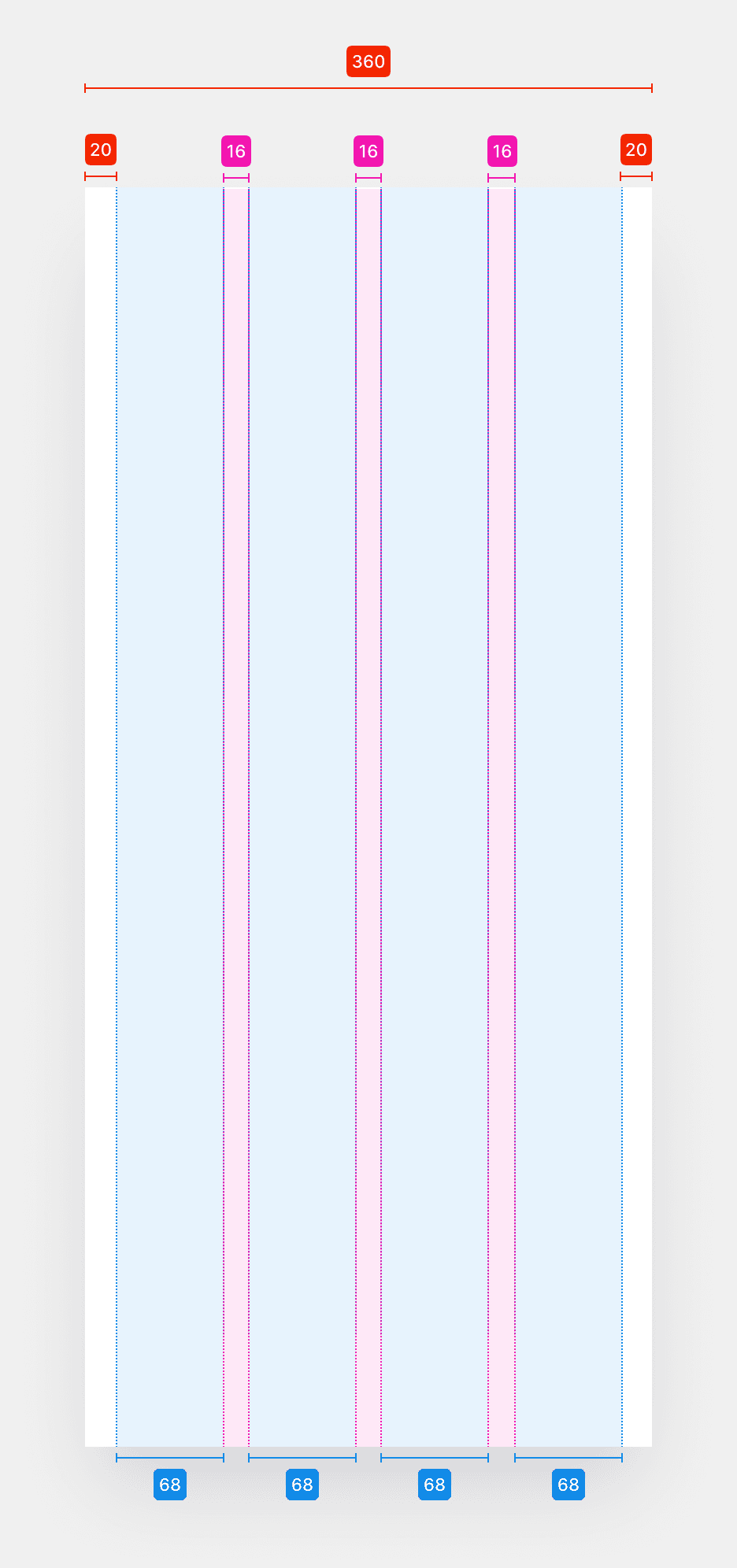
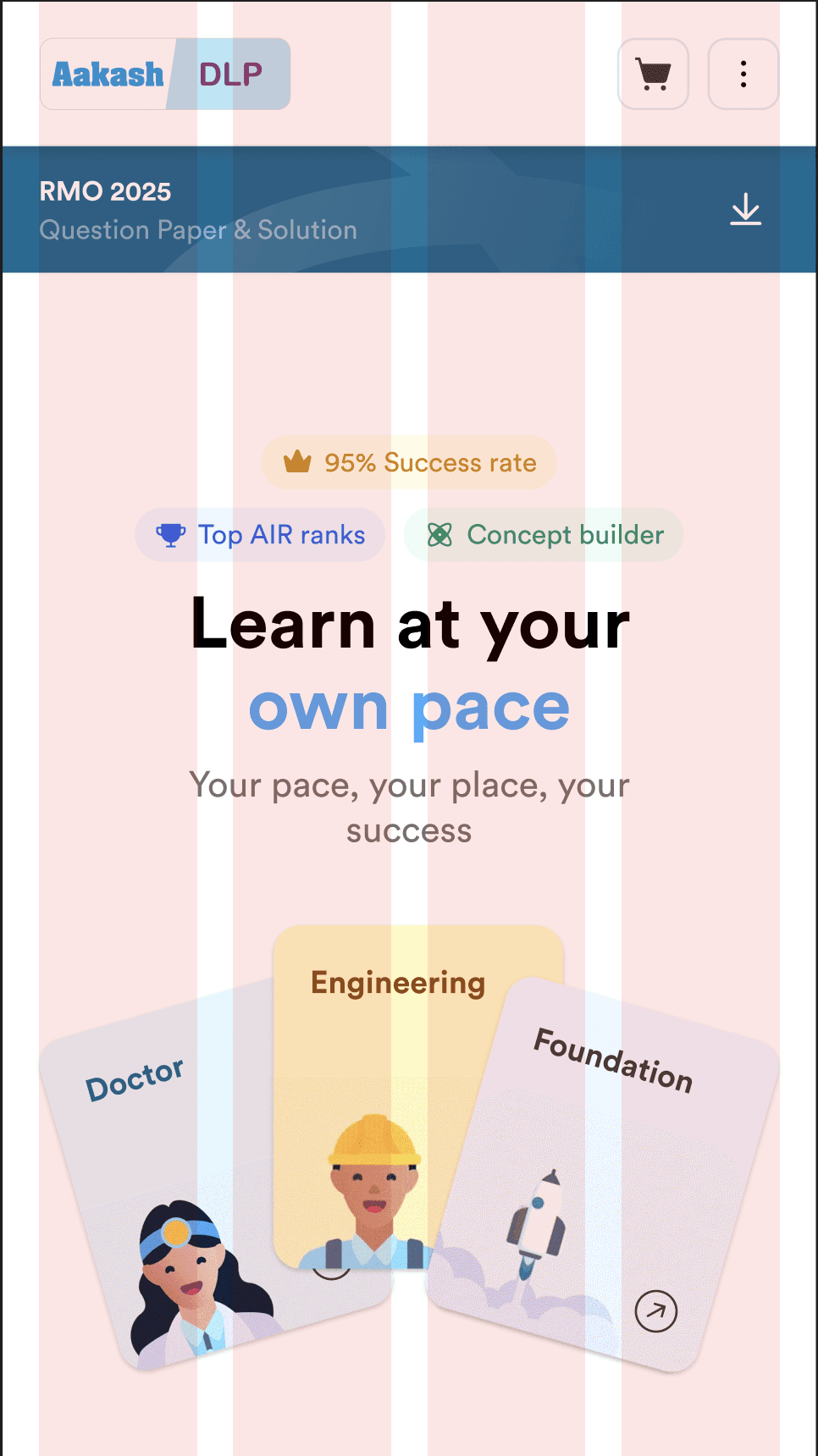
The grid was designed to scale cleanly from mobile to web. A 4-column grid at 360px maps directly to a 12-column grid at 1200px (4×3), allowing three mobile screens to fit seamlessly into the web layout. This made responsive design predictable and enabled teams to reuse layouts across breakpoints with minimal rework
The grid was designed to scale cleanly from mobile to web. A 4-column grid at 360px maps directly to a 12-column grid at 1200px (4×3), allowing three mobile screens to fit seamlessly into the web layout. This made responsive design predictable and enabled teams to reuse layouts across breakpoints with minimal rework
Some of the components
Some of the components
Sneakpeak into base universe,
Sneakpeak into base universe,
Buttons
Buttons
5 Variations, 4 Sizes, 7 Products
5 Variations, 4 Sizes, 7 Products
Inputs
7 States, 10 Variants
7 States, 10 Variants
Dropdowns
Includes search, multiselect, descriptive liners & icons
Includes search, multiselect, descriptive liners & icons
Cards
Clubbing content into scannable layouts
Clubbing content into scannable layouts
Bottom navigation
Both in dark or light, upto 5 tabs max
Both in dark or light, upto 5 tabs max
Skeleton
Simple loader for most of the usecases
Simple loader for most of the usecases
Badges
Most used component with lot of variations
Most used component with lot of variations
Toasts
Feedback without interrupting user flow
Feedback without interrupting user flow
Calendar
Date duration or multiple individual days
Date duration or multiple individual days
Tables
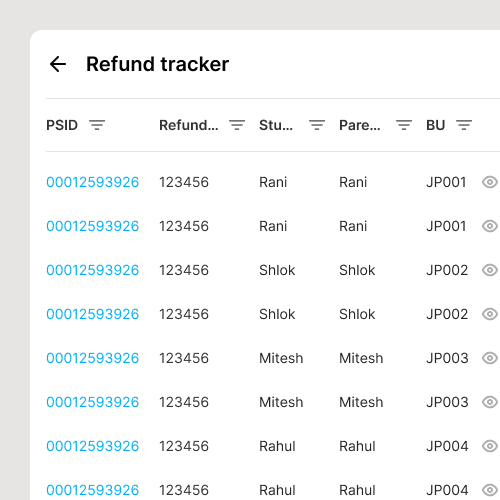
Over 60% of enterprise product workflows relied on tables as the primary layout
Over 60% of enterprise product workflows relied on tables as the primary layout
And 80+ unique components, which powered 7 products
Collaboration highlights
Collaboration highlights
Team sync is everything while building a system
Team sync is everything while building a system
Every week became a huddle of designers, engineers, and PMs untangling these differences together. These syncs became alignment rituals that kept everyone moving in one direction. Bit by bit, the system started to feel like one unified product, not seven stitched together
Every week became a huddle of designers, engineers, and PMs untangling these differences together. These syncs became alignment rituals that kept everyone moving in one direction. Bit by bit, the system started to feel like one unified product, not seven stitched together
Cross-functional syncs with the team
Design UAT Sessions
Launch
March 2026
March 2026
We are planning to launch it in upcoming months, once development of all the comps is ready. Till now we have released 30% of the designs across all products and have acheived
We are planning to launch it in upcoming months, once development of all the comps is ready. Till now we have released 30% of the designs across all products and have acheived
-30%
-30%
Design to dev
Design to dev
9.2
9.2
Design consistency audit scores
Design consistency audit scores
Future roadmap
Future roadmap
Here are our plans for future
Here are our plans for future
Track component usage
Track component usage
Better code-connect integration for two-way sync
Better code-connect integration for two-way sync
Explore illustrations layer as per brands
Explore illustrations layer as per brands
JUMP TO
JUMP TO